
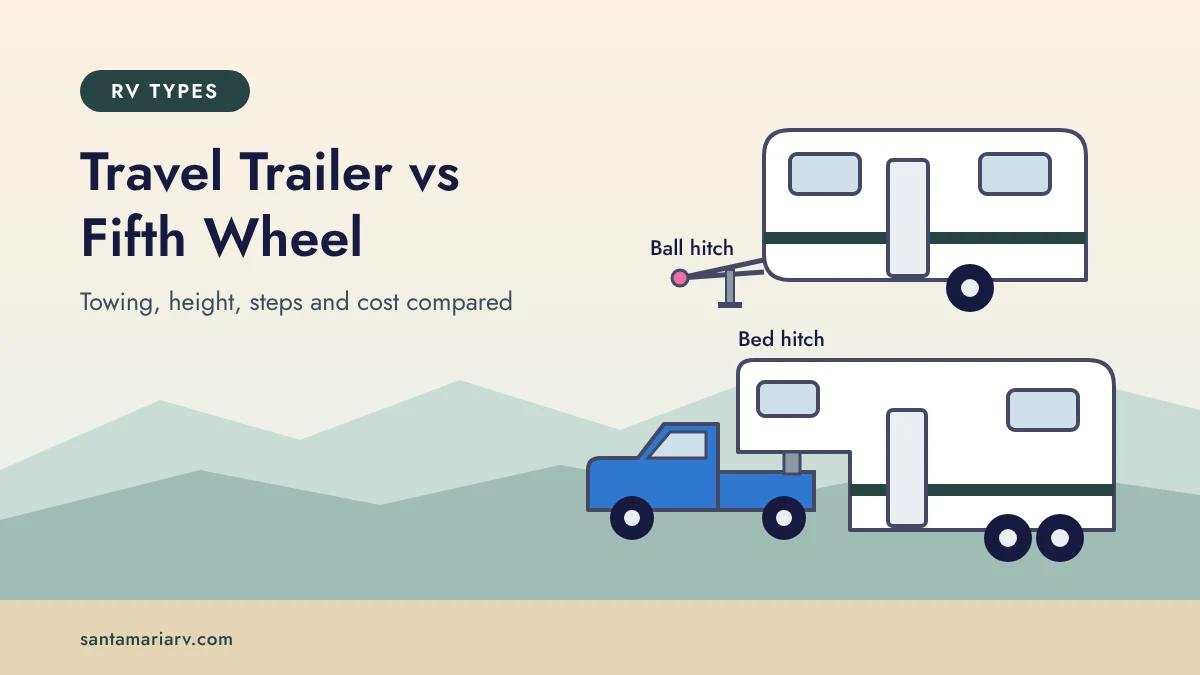
In the travel trailer vs fifth wheel decision, the short answer is this: a travel trailer is cheaper, lower and can be towed by more kinds of vehicles, while a fifth wheel tows more steadily and usually gives you taller ceilings and more storage, but it needs a pickup truck and has a raised front deck reached by interior steps. Which one is easier to live with depends on your truck, your knees and how long you stay in one place.
Both are towable RVs, not motorhome classes; our guide to RV classes and towable types shows where they fit in the bigger picture.
Travel Trailer vs Fifth Wheel at a Glance
To compare like with like, the table uses two 2026 models from the same Jayco product line with nearly the same empty weight: the Eagle HT 294CKBS travel trailer and the Eagle HT 29RLC fifth wheel. Specs are manufacturer-listed and were checked in November 2026; they are examples, not averages.
| Criterion | Travel trailer (Eagle HT 294CKBS) | Fifth wheel (Eagle HT 29RLC) |
|---|---|---|
| Starting price (Jayco, as of Nov 2026) | $45,375 | $53,250 |
| Hitch | Ball hitch at the rear of the tow vehicle | Hitch in the pickup bed |
| Unloaded weight | 9,660 lb | 9,485 lb |
| Dry hitch weight | 1,290 lb | 1,635 lb |
| Overall length | 37 ft 11 in | 34 ft 1 in |
| Exterior height | 11 ft 6 in (11 ft 11 in with A/C) | 12 ft 3 in (12 ft 4 in with A/C) |
| Interior height | 7 ft 0 in main, 7 ft 0 in upper deck | 8 ft 6 in main, 6 ft 2 in upper deck |
| Cargo carrying capacity | 2,040 lb | 1,715 lb |
| Tanks (fresh / gray / black) | 52 / 74 / 37 gal | 52 / 82 / 45 gal |
Check current prices with a dealer; Jayco notes that specs and features can change without notice.
How the Hitch Changes Towing
The biggest difference between the two is where the trailer connects to your vehicle.
A travel trailer couples to a ball hitch behind the rear bumper. The Ford 2025 RV and Trailer Towing Guide says travel trailers are “normally towed with a conventional weight-distributing hitch, depending on weight,” and its F-150 towing charts say not to exceed 5,000 pounds of trailer weight without a weight-distribution system. The California DMV Recreational Vehicles and Trailers Handbook says hitch weight for travel trailers should typically be at least 10 percent of the trailer’s gross weight, and in some cases 15 percent or more.
A fifth wheel couples to a hitch mounted in the bed of a pickup. Ford says the hitch should sit at least two inches forward of the truck’s rear axle, and that fifth wheels offer “improved weight distribution and towing dynamics, since some trailer weight is directly over the towing vehicle.” The California DMV handbook calls fifth wheels “basically very stable” and puts their hitch weight at around 20 percent of the trailer weight.
Hitch weight (also called tongue weight, or pin weight on a fifth wheel) is the part of the trailer’s weight that presses down on your vehicle. Ford counts it as cargo, so it uses up your truck’s payload.
What hitch weight means for your truck
In our Jayco example, the dry hitch weight is about 13% of unloaded weight for the travel trailer and about 17% for the fifth wheel (our own calculation from Jayco’s figures). Once you load gear and water, the hitch weight in pounds goes up too.
Keystone RV recommends keeping a fifth wheel’s loaded pin weight between 15% and 25% of the total weight, and choosing a truck with a trailer rating of at least the trailer’s GVWR (gross vehicle weight rating, the most it may weigh fully loaded). Ford adds that the tongue load or king pin weight must not push the truck over its GVWR or rear axle rating.
Match the truck to the trailer’s GVWR and pin or tongue weight, not to its empty weight. Use the towing guide for your exact truck, and have a hitch professional install a fifth-wheel or weight-distributing hitch.
Fifth Wheel vs Travel Trailer: Tow Vehicle and Truck Bed
A fifth wheel needs a pickup; Keystone and the Escapees RV Club both say so. A travel trailer can be pulled by “a wide variety of vehicles, not just pickup trucks,” Escapees notes, as long as the vehicle is rated for its weight. A small travel trailer may suit an SUV you already own; the 9,660-pound model in our table does not.
The hitch also takes over the truck bed. “Much of the truck bed space is not available,” the California DMV handbook says of fifth wheels. Short-bed trucks have a further issue: Ford warns that shorter pickup boxes give less clearance between the trailer and the cab, and the setup must clear the cab in turns of up to 90 degrees. Ask your hitch installer how your truck and trailer will handle tight turns.
Bigger trucks and bigger weights can also bring licensing rules. Some states require a special license or endorsement for heavy trailers; see our guide to RV license requirements by state.
Height, Length and Where You Can Go
Fifth wheels are taller. In our example, the fifth wheel stands 12 ft 3 in versus 11 ft 6 in for the travel trailer (both before A/C units). Keystone notes that some of the biggest fifth wheels “stand 13-feet tall.” Escapees warns that “the taller profile of fifth wheels can limit access to certain roads and underpasses,” so check posted clearances on low bridges, fuel station canopies and tree-lined campground roads.
Length works the other way. The front of a fifth wheel rides over the truck bed, so a fifth wheel with similar weight can have a shorter overall length: 34 ft 1 in versus 37 ft 11 in in our Jayco pair. Escapees still says travel trailers are typically shorter once unhitched, “making it easier to fit into tighter campsite spaces”; our Jayco pair shows that is not always true. Always compare the site length a campground lists with your trailer’s overall length.
Living Space, Steps and Comfort
This is where “easier to live with” gets personal.
- Ceilings. The Jayco fifth wheel lists an 8 ft 6 in main ceiling, against 7 ft in the travel trailer. Escapees notes that travel trailers typically have lower ceilings and less spacious interiors than fifth wheels.
- Split level. A fifth wheel has a raised upper deck over the hitch. In the 29RLC, Jayco lists 6 ft 2 in of headroom on that deck. Escapees notes the multi-level layout often gives a clear separation between the living area and the bedroom.
- Steps inside. Reaching a fifth wheel’s upper deck means climbing interior steps. Some travel trailers have a raised section too: Jayco lists both a main and an upper-deck interior height (7 ft 0 in each) for the 294CKBS, so check the floorplan of any model you consider.
- Storage. Escapees says fifth wheels have “larger storage bays under the living quarters,” while travel trailers usually have less exterior storage.
- Tanks. The fifth wheel in our table carries more gray and black water capacity (82 and 45 gallons versus 74 and 37), which can mean fewer trips to the dump station.
If stairs or a bad knee are a concern, walk through both types at a dealer and climb the fifth wheel’s interior steps a few times. Check the handrail, step height and how easily you can get in and out of the bed.
Riding inside while towing
Passengers riding in a trailer is a state law question. In California, Vehicle Code §21712 bars people from riding in a towed trailer coach, with an exception for one towed with a fifth-wheel device that has safety glazing, a signaling device for passengers and an exit that opens from inside and out. Other states have their own rules; check them before anyone rides in the trailer.
Cost to Buy and Own
The fifth wheel in our table starts $7,875 higher than the travel trailer of similar weight (our own calculation from Jayco’s starting prices as of November 2026). Escapees writes that fifth wheels are “generally” more expensive “both in initial purchase and upkeep.”
The tow vehicle matters as much as the trailer. If you already own a capable pickup, the gap is smaller. If you would need to buy a truck for a fifth wheel but could tow a lighter travel trailer with your current vehicle, the travel trailer route costs much less overall. Prices, insurance and registration vary by model and state, so get written quotes before you decide.
Which One Should You Choose?
There is no single winner. Match the trailer to how you travel:
- A retired couple taking two- to four-week trips: a mid-size travel trailer if you want a lower purchase price and to keep your current tow vehicle (if it is rated for the weight). A fifth wheel if you already own a heavy-duty pickup and want steadier towing.
- Full-timers or long-stay snowbirds: a fifth wheel’s taller ceilings and larger storage bays suit living in one place for months; compare tank sizes floorplan by floorplan. Our full-time RV living guide covers what else to plan for.
- Weekend campers: a smaller travel trailer is usually the simpler and cheaper start, and it fits more campsites.
- Travelers with limited mobility: a floorplan without a raised section avoids interior steps, so look at the layout, not just the trailer type. If you prefer a fifth wheel, look for floorplans with fewer steps, sturdy handrails and a bed you can reach from both sides.
Frequently Asked Questions
Is a fifth wheel easier to tow than a travel trailer?
Generally, yes. Ford says fifth wheels offer improved weight distribution and towing dynamics because part of the trailer’s weight sits directly over the truck, and the California DMV handbook calls them very stable. You still need a pickup rated for the trailer’s weight and pin weight, plus practice in turns and backing.
Can you tow a fifth wheel with a half-ton truck?
Sometimes, but only if the truck’s ratings allow it. Keystone lists half-ton, three-quarter-ton and one-ton trucks as options and says to choose a truck rated for at least the trailer’s GVWR. Ford adds that king pin weight counts as cargo, so it uses up the truck’s payload and must not push it past its GVWR or rear axle rating.
Why are fifth wheels more expensive than travel trailers?
In our Jayco example, the fifth wheel starts $7,875 higher than a travel trailer of similar weight. Escapees says fifth wheels generally cost more to buy and to maintain. A fifth wheel also requires a pickup with a bed-mounted hitch, which adds cost if you do not already own one.
Can passengers ride in a fifth wheel while it is being towed?
It depends on the state. California bans riding in a towed trailer coach but exempts fifth wheels that have safety glazing, a way to signal the driver and an exit that opens from inside and outside, under Vehicle Code §21712. Check the law in every state on your route first.