
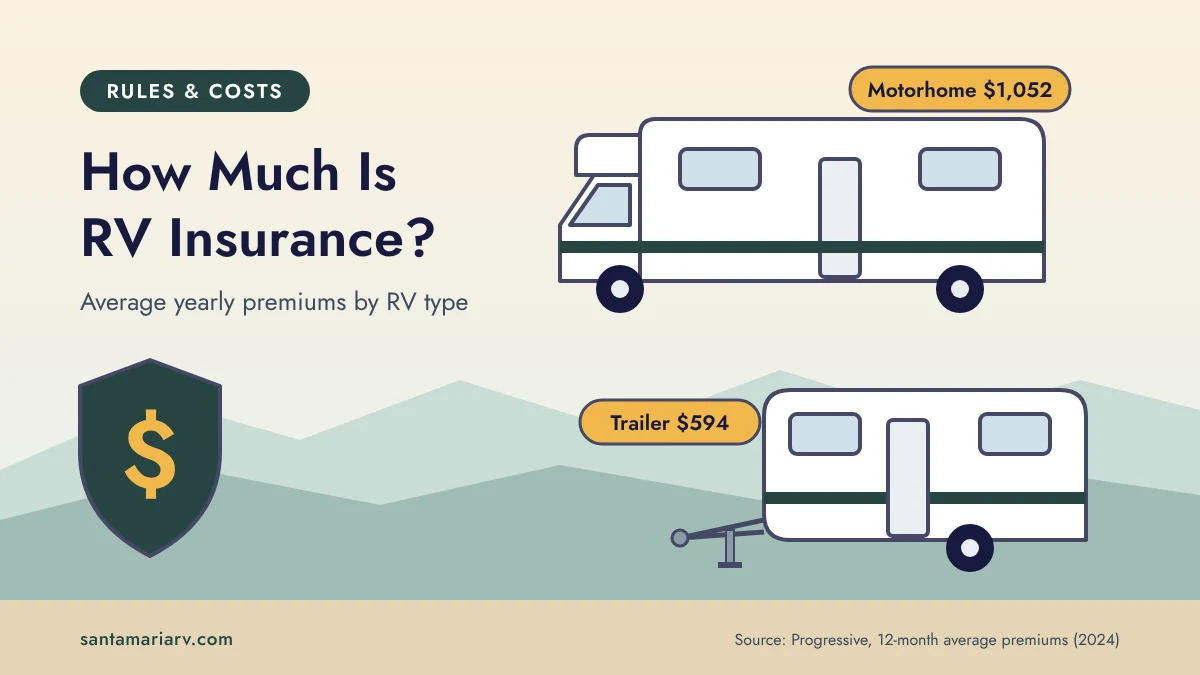
Your RV insurance cost depends mostly on what kind of RV you own, where you live and how you use it. According to Progressive, the average 12-month policy it wrote in 2024 cost $594 for a travel trailer and $1,052 for a motorhome. Your own quote can be far lower or higher, so treat these figures as a starting point, not a price.
This is general information, not insurance advice. Prices and coverage rules change; get written quotes and check current terms with the insurer before you buy.
RV Insurance Costs by Type at a Glance
The only published averages we could find come from insurers themselves, and they describe their own customers rather than the whole market. Progressive also publishes averages for individual states, which show how much location matters. All figures below are Progressive’s average 12-month premiums for 2024, checked in November 2026.
| Where | Travel trailer | Motorhome | Source |
|---|---|---|---|
| Countrywide | $594 | $1,052 | Progressive |
| Florida | $841 | $1,386 | Progressive, Florida |
| Minnesota | $507 | $882 | Progressive, Minnesota |
| Delaware | $394 | $969 | Progressive, Delaware |
State figures are rounded to the nearest dollar. Progressive does not split motorhomes by class in these tables, but it notes that Class A motorhomes typically cost more to insure than Class C and Class B models. If you are unsure which class you own, our guide to RV classes explains the differences.
At the low end, Progressive says liability-only coverage for a motorhome starts at $125 a year, though that option is not available in all states and does not apply to travel trailers. Good Sam Insurance Agency advertises RV coverage “for as little as $15/Month,” and says cost will vary based on insurer and coverage selections.
How Much Is RV Insurance per Month?
Progressive’s averages are for 12-month policies. Dividing Progressive’s 2024 countrywide averages by 12 gives roughly $50 a month for a travel trailer and about $88 a month for a motorhome. Good Sam lists paying the premium in full among its discounts, so ask your insurer whether paying once a year costs less than monthly payments.
Why Motorhomes Cost More to Insure Than Towables
Part of the difference is liability. A motorhome is a vehicle you drive, so it needs its own liability coverage. Progressive’s coverage page says liability is required by law if you drive a motorhome. The Texas Department of Insurance gives the same rule for Texas: you need an auto policy with liability coverage for the motorhome.
A travel trailer or fifth wheel works differently. Progressive’s travel trailer coverage page says liability is not offered on its trailer policies, because “in nearly every state, you’re required to have liability coverage on the vehicle that tows your travel trailer.” The Texas Department of Insurance adds that your auto policy might cover accidents you cause while towing, but you probably need a separate RV policy or endorsement to cover damage to the trailer itself.
What a trailer policy pays for is mostly damage to the trailer and its contents. Progressive’s cost guide says travel trailer policies must include comprehensive and collision coverage even if the trailer is not financed. Medical payments coverage, which pays medical bills after a motorhome accident, is not available on its travel trailer policies.
If you are still choosing between towable types, our travel trailer vs fifth wheel comparison covers the other cost differences.
What Drives Your RV Insurance Premium
Two official lists of rating factors overlap closely. The Maryland Insurance Administration and Progressive name these:
- RV type, size and age. Vehicle class, RV size and age all appear on Maryland’s list; Progressive adds condition.
- How you use it. Vacation use versus living in the RV, and annual miles driven.
- Where you live and travel. Progressive says rates depend on state, region and ZIP code, and areas prone to severe weather or theft may cost more.
- Coverages, limits and deductibles. Higher limits and extras such as roadside assistance raise the price; a higher deductible lowers it.
- Custom features. Maryland lists them as a separate factor.
- Your record. Driving record, claims history and, according to Progressive, your experience driving an RV.
- Financing. Progressive says financed RVs usually require comprehensive and collision coverage.
Progressive’s state tables above show the location effect clearly: its 2024 average motorhome premium in Florida was $1,386, compared with $882 in Minnesota.
Optional Coverages That Change the Price
Basic coverage protects you against claims and pays for damage to the RV. Optional coverages add protection and cost. The limits below are Progressive’s published terms as of November 2026; other insurers’ terms differ.
| Coverage | What it does | Example terms |
|---|---|---|
| Vacation liability | Injuries in or around your RV while you’re on vacation | $10,000 base, upgradable to $500,000 (Progressive) |
| Emergency expense | Hotel, food and transportation if the RV is disabled far from home | Up to $750 when more than 50 miles from your primary residence (Progressive) |
| Total loss replacement | A new RV, or your purchase price, if yours is totaled | Qualified new RVs only (Progressive); first five model years for the new-RV option (Good Sam) |
| Personal belongings | Items you carry inside the RV | “Up to $3,000 or more can be added” (Good Sam) |
| Roadside assistance | Towing, fuel delivery, flat tires, dead batteries | Towing if disabled within 100 feet of a road or highway (Progressive) |
| Roof protection | Roof repair, including wear and tear | RV under six years old, $250 deductible (Progressive) |
| Pet injury | Vet bills after an accident while your dog or cat rides along | Up to $1,000, no deductible (Progressive) |
The Texas Department of Insurance warns that your home policy may pay for some RV contents, but coverage is very limited. Ask your agent how much contents coverage you have and whether you can buy more.
Full-Time RV Insurance Cost and Coverage
If the RV is your home, expect to pay for more coverage. Progressive says living in your RV six or more months a year may require homeowners-style coverages. Good Sam describes its full-timer coverage as “designed to provide protection similar to a homeowners policy” for people who live in their RV more than six months a year.
According to the Texas Department of Insurance, full-timers coverage includes personal property and liability coverage. That liability pays when you are not driving, for example if someone is injured inside your RV. No insurer we checked publishes an average price for full-timer policies, so you will need quotes. Our full-time RV living guide covers domicile and other insurance questions that come with life on the road.
How to Lower What You Pay
Insurers publish their own discounts, and availability varies by state:
- Bundle policies. Progressive offers a multi-policy discount for bundling RV coverage with its other policies, and Good Sam lists a discount for bundling your RV and automobile.
- Keep a clean record. Progressive’s responsible driver discount requires no accidents or violations in the past three years; it also offers a claim-free renewal discount.
- Ask about storage options. Good Sam’s storage option lets you turn off coverages you don’t need when the RV is stored for 30 days or more, while comprehensive coverage stays in effect against theft, fire and storms. The Maryland Insurance Administration says some insurers let you suspend collision coverage during storage.
- Raise your deductible carefully. Progressive says raising your comprehensive and collision deductibles can lower the premium. Remember that you pay the deductible yourself when you file a claim.
- Check membership discounts. Good Sam lists a discount for Good Sam Club members.
Before you drop coverage on a stored RV, check with your state and your lender. The Maryland Insurance Administration notes that liability coverage is still required if the RV is registered in Maryland, and Good Sam says storage coverage is subject to state and lienholder requirements.
If your RV sits for the winter, our guide on how to winterize an RV covers the preparation side. Licensing rules for larger motorhomes are a separate question; see whether you need a special license to drive an RV.
Which Coverage Level Is Right for You?
- Weekend trips with a paid-off travel trailer: Your auto policy might cover accidents you cause while towing, so confirm that with your auto insurer. Compare comprehensive and collision deductibles, and ask whether your auto insurer can bundle the trailer.
- Snowbirds with a motorhome: You need liability while you drive. Ask about vacation liability for long campground stays, emergency expense coverage, and a storage option for the months the RV sits.
- Full-timers: Ask specifically for full-timer coverage, contents coverage and liability for when the RV is parked.
- A new or financed RV: Progressive says financed RVs usually require comprehensive and collision. Total loss replacement may be worth pricing while the RV is in its first model years.
Get at least two or three quotes with the same limits and deductibles so you are comparing like with like. If a policy is hard to understand, your state insurance department can help; the Texas Department of Insurance, for example, takes questions at 800-252-3439.
Frequently Asked Questions
How much does RV insurance cost per month?
Based on Progressive’s 2024 countrywide averages of $594 a year for a travel trailer and $1,052 for a motorhome, that works out to roughly $50 and $88 a month. Good Sam advertises policies from $15 a month. Your rate depends on RV type, location, coverage and driving record.
Is RV insurance required?
For a motorhome, yes: liability coverage is required by law because you drive it, according to Progressive and the Texas Department of Insurance. A travel trailer usually relies on the tow vehicle’s liability, but lenders and some states have their own rules. Maryland, for example, requires liability coverage to register an RV.
Does my car insurance cover my travel trailer?
Partly. The Texas Department of Insurance says your auto policy might cover accidents you cause while towing, but you probably need a separate RV policy or endorsement to cover damage to the trailer itself. A home policy might pay for some contents, but that coverage is very limited, so check both policies with your agent.
Do I need RV insurance while my RV is in storage?
Usually you keep some coverage. Some insurers let you suspend collision while the RV is stored, and comprehensive stays in effect for theft, fire and storms. Maryland’s insurance regulator says liability is still required for an RV registered there. Check your state and lender rules first.
Why is Class A RV insurance more expensive?
Progressive says Class A motorhomes typically cost more to insure than Class C and Class B models. Insurers rate premiums partly on vehicle class, size and age, and a motorhome also needs its own liability coverage. Get quotes for the exact model you are considering before you buy.