
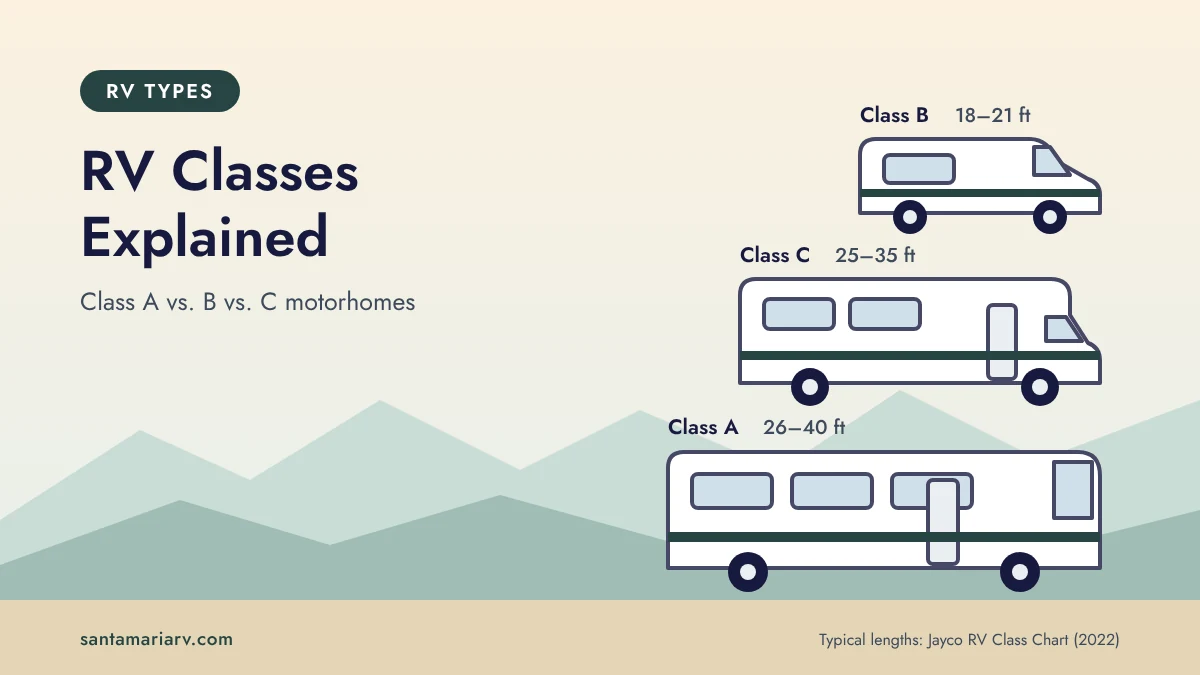
RV classes describe the three kinds of motorhomes you drive: Class A (the bus-shaped coach), Class B (the camper van) and Class C (the motorhome with a bed over the cab). Each class is defined by the type of chassis it is built on, as Progressive’s guide to RV types explains. Towable RVs — travel trailers, fifth wheels, toy haulers and pop-ups — are not “classes,” but they are the other half of the RV world, and we cover them below.
The short version: Class B is the smallest and easiest to park, Class A has the most room, and Class C sits in between.
RV Classes at a Glance
Length and sleeping figures below come from Jayco’s RV class chart (2022). Jayco is an RV manufacturer, and these are typical ranges, not limits.
| Class | Built on | Typical length | Sleeps | Good fit for |
|---|---|---|---|---|
| Class A | Bus or commercial truck chassis | About 26–40 ft | 6 or more | Long stays, couples who want the most space |
| Class B (camper van) | Van chassis | About 18–21 ft | 2 | Couples, frequent movers, narrow roads and tight parking |
| Class C | Cutaway van or smaller commercial truck chassis | About 25–35 ft | 4–9 | Couples who want more room, family or grandkids along |
Jayco notes that motorhomes typically run on gas or diesel.
Class A Motorhomes
A Class A is the largest motorhome: a flat-front, bus-style coach “built with the same framing and construction as commercial trucks and buses,” as Thor Industries describes it. Go RVing, the RV industry’s consumer site, says they sleep up to 8 people and typically have a full kitchen, a full-size bathroom and large living areas.
What to expect:
- Space: Thor lists large pass-through exterior storage compartments and multiple slide-outs that add living and storage space.
- Towing a car: Go RVing notes that Class A owners can tow another vehicle for side trips, and Jayco says most people choose to tow one behind their Class A.
- Driving: Go RVing says the driver’s seat is not dramatically different from other vehicles, and that backup cameras and alert systems help newcomers with some practice. Because of their size, you may need a special non-commercial driver’s license for a Class A, according to Progressive — check your state’s DMV.
- Example models from Thor’s lineup: the Thor Motor Coach Hurricane (30 ft 11 in to 37 ft, sleeps up to 7) and the Tiffin Phaeton (37 ft 9 in to 45 ft, sleeps up to 8).
Class B Motorhomes (Camper Vans)
A Class B is a van fitted out as a motorhome. Go RVing says it is “compact enough to make driving one as easy as your regular van or SUV” and sleeps 2 to 4 people. Jayco’s chart puts typical length at about 18 to 21 feet.
What to expect:
- Easy driving and parking: Thor calls Class B vans ideal for narrow roads and congested streets and simple to maneuver, park and turn around.
- Compact living: Go RVing describes a compact kitchen, and many models have a wet bath (the shower and toilet share one space) or a dry bath. Thor notes that most Class B motorhomes do not offer slide-outs.
- Service: Thor notes that chassis and engine service is available at many automotive dealerships.
- Example models: Thor Motor Coach Scope (17 ft 11 in) and Jayco Swift (20 ft 11 in), per Thor.
Class C Motorhomes
A Class C is easy to spot by the “over-the-cab portion that is often an optional sleeping area,” as Go RVing puts it. Go RVing describes an automotive van frame with a wider body section attached to the original cab; Jayco’s chart adds that some are built on a smaller commercial truck chassis.
What to expect:
- Bedroom and sleeping space: Go RVing says Class C models can be large enough to include a separate bedroom with a king or queen bed. Thor describes the raised area over the cab as sleeping or storage space.
- Familiar driving position: you drive from the original van or truck cab. Thor adds that Class Cs are frequently shorter and not as tall as a Class A, and that most have at least one slide-out.
- Towing a car: Go RVing says a Class C can tow another vehicle for side trips, but Thor notes that Class Cs have somewhat limited towing capacity compared with a Class A, so check the model’s rating.
- Example models: Thor Motor Coach Four Winds (20 ft 5 in to 32 ft 8 in), per Thor. Thor also lists the Jayco Seneca (39 ft 4 in) under Class C; Jayco itself markets the Seneca as a Super C.
What about Super C?
A Super C is a heavier-duty version of a Class C. Thor says it has “towing capacity rivaling many Class A motorhomes.” For example, Jayco’s Seneca, which Jayco calls a “diesel Super C,” is built on a Freightliner chassis with a Cummins diesel engine and is rated to tow 12,000 pounds. At 39 ft 4 in, it is also longer than the typical Class C range in Jayco’s chart.
Class A vs Class C vs Class B: How They Compare
| Class A | Class C | Class B | |
|---|---|---|---|
| Typical length (Jayco) | About 26–40 ft | About 25–35 ft | About 18–21 ft |
| Sleeps (Jayco) | 6 or more | 4–9 | 2 |
| Interior space | Most | Medium | Least |
| Separate bedroom | Layout allows one | Possible in larger models | Limited by size |
| Maneuvering and parking | Largest to handle | More maneuverable than a Class A | Easiest |
| Towing a car behind | Higher towing capacity | Somewhat limited (Super C is higher) | Check the model’s rating |
This comparison is a general guide based on the sources above; always check the specific model’s length, weight and towing rating.
Towable RV Types
Towables have no engine and need a tow vehicle. Jayco’s chart gives these typical ranges:
| Towable type | Typical length | Typical weight | Sleeps |
|---|---|---|---|
| Travel trailer | 13–40 ft | 1,585 to 12,500+ lb | 3–14 |
| Fifth wheel | 29–45 ft | 7,880 to 14,500 lb | 8–11 |
| Toy hauler (with rear garage; Jayco’s own models) | 26–47 ft | 5,785 to 16,000 lb | Up to 10 |
| Pop-up camper | 8–16 ft packed | 700 to 4,000 lb | 2–8 |
- Travel trailers can be towed by an SUV or pickup with a ball-and-coupler hitch, according to Progressive.
- Fifth wheels need a pickup with a hitch in the truck bed, as Progressive explains. Jayco’s ranges show they run longer and heavier than many travel trailers.
- Truck campers sit in the bed of a pickup.
The big advantage of a towable, as Jayco puts it: you can unhitch and drive your vehicle around without worrying about the RV.
Which RV Class Is Right for You?
- A couple who moves often and wants easy driving: a Class B, or a short Class C.
- Snowbirds who stay put for weeks: a Class A or a larger Class C, which give more space for long stays; both can tow a car for side trips.
- Couples who want a fixed bed and room for visiting grandkids: a Class C with a separate bedroom and the cab-over bunk.
- Travelers who already own a capable pickup: a travel trailer or fifth wheel. Jayco notes that towables are generally sold at a lower price point than motorhomes because they have no engine.
- Anyone with limited mobility: look at the entry steps, the bed and the bathroom layout in person before buying, and check the bed against our RV mattress sizes chart. Renting first is one way to find out what works for you.
Frequently Asked Questions
What are the three classes of RVs?
The three classes are Class A (bus-style motorhomes), Class B (camper vans) and Class C (motorhomes with a cab-over bunk). Each is defined by the type of chassis it is built on. Travel trailers and fifth wheels are towable RVs and are not part of the class system.
Which RV class is the easiest to drive?
Class B camper vans are generally the easiest. Go RVing says driving one is as easy as a regular van or SUV, and Thor calls them simple to maneuver, park and turn around. At about 18 to 21 feet, they are the shortest motorhomes in Jayco’s chart.
Is a Class C bigger than a Class B?
Yes. A Class C is typically about 25 to 35 feet long and sleeps 4 to 9, while a Class B is about 18 to 21 feet and sleeps 2, according to Jayco’s chart. A Class C also has the cab-over area for sleeping or storage, and Go RVing says some are large enough for a separate bedroom.
Why is a Class B smaller than a Class C?
The letters are not a size order. They describe the build: a Class B is a converted van, while a Class C adds a wider living body and a cab-over section to a van or truck cab, which makes it bigger. In Jayco’s chart, a Class B runs about 18 to 21 feet and a Class C about 25 to 35 feet.
Do you need a special license to drive a Class A motorhome?
Possibly. Progressive notes that because of their size, you may need a special non-commercial driver’s license to operate a Class A motorhome. License rules are set by each state; our guide to RV license requirements by state explains the weight limits that matter.