
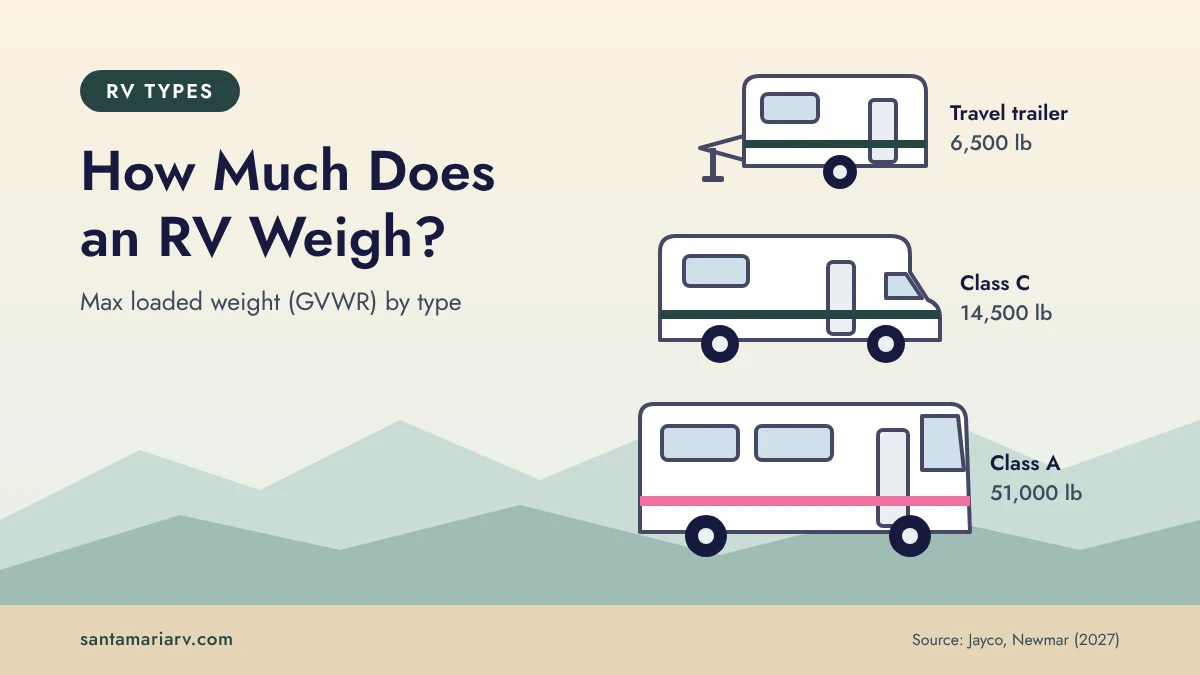
How much does an RV weigh? Anywhere from about 700 pounds for a small pop-up to a loaded rating of more than 50,000 pounds for the biggest diesel coaches. Jayco’s RV class chart says most pop-up campers weigh 700 to 4,000 pounds, while Newmar gives its 2027 Dutch Star 4369 diesel coach a maximum loaded weight (GVWR) of 51,000 or 52,000 pounds, depending on the chassis.
Most RVs fall in between. The number that matters for you is not one “average” but two figures for your exact model: what it weighs empty and the most it may weigh loaded. Both are in the manufacturer’s specs, the loaded limit is on a label the RV must carry, and we show you where below.
How Much Does an RV Weigh by Type?
The examples below are manufacturer specifications checked in November 2026. They show typical sizes in each group, not limits. Floor plans, options and model years change the numbers.
| RV type | Example (manufacturer spec) | Empty weight (UVW or base weight) | Max loaded weight (GVWR) |
|---|---|---|---|
| Pop-up camper | Range for most models (Jayco) | 700–4,000 lb | — |
| Small travel trailer | Airstream Basecamp 16X, 2026 (Airstream) | 2,700 lb (base weight) | 3,500 lb |
| Mid-size travel trailer | Jayco Jay Flight 260BH, 2027 (Jayco) | 4,750 lb | 6,500 lb |
| Fifth wheel | Jayco Eagle 29RLC, 2027 (Jayco) | 9,420 lb | 11,200 lb |
| Large fifth wheel | Jayco Eagle 367TBTS, 2027 (Jayco) | 12,525 lb | 14,900 lb |
| Class B (camper van) | Winnebago Travato (Winnebago) | Not published | 9,350 lb |
| Class C | Thor Four Winds 22Z, 2027 (Thor Motor Coach) | Not published | 12,500 lb |
| Class C | Jayco Redhawk 26M, 2027 (Jayco) | Not published | 14,500 lb |
| Super C | Jayco Seneca 37K, 2027 (Jayco) | Not published | 31,000 lb |
| Class A (gas) | Thor Hurricane, 2027 floor plans (Thor Motor Coach) | Not published | 18,000–24,000 lb |
| Class A (diesel) | Newmar Dutch Star 4369, 2027 (Newmar) | About 40,000 lb (approx.) | 51,000–52,000 lb |
Not sure which type is which? Our guide to RV classes explained covers the differences in size and driving.
Dry Weight vs GVWR: The Weight Terms on Your RV
RV specs use several weight terms, and they are easy to mix up. Here is what each one means, using the definitions on Forest River’s RV definitions page and, for towing terms, the Ford RV and Trailer Towing Guide:
- UVW (unloaded vehicle weight). Often called dry weight. The weight of the RV as built at the factory. For a towable it includes the weight on the tongue or pin and LP gas. For a motorhome it also includes full fuel and all fluids. It does not include cargo, fresh water, optional equipment or dealer-installed accessories.
- GVWR (gross vehicle weight rating). The most the RV may weigh fully loaded, with water, cargo, options and, in a motorhome, passengers. Forest River’s advice is plain: do not exceed it.
- CCC (cargo carrying capacity). GVWR minus UVW. This is what you have left for water, food, clothes, tools, accessories and, in a motorhome, people.
- GAWR (gross axle weight rating). The most each axle (or, on a towable, all axles together) may carry.
- GCWR (gross combined weight rating). For a motorhome, the most it plus any towed trailer or car may weigh; for a tow vehicle, the most it plus the loaded trailer may weigh.
- Hitch weight. The part of a trailer’s weight that presses down on the hitch: tongue weight on a travel trailer, king pin weight on a fifth wheel.
Forest River also notes that load capacity is set by weight, not by volume, so you cannot always fill every cabinet. Its UVW and CCC figures are estimates based on standard equipment; options and dealer add-ons reduce the cargo capacity you actually have.
The “base weight” Airstream lists and the “dry weight” in many ads are close cousins of UVW, but each company decides what it includes. Compare models on GVWR and cargo capacity, not on the lowest empty weight in a brochure.
How Much Does a Motorhome Weigh?
The motorhome makers in our table publish GVWR, but most leave out the empty weight. Winnebago, for example, leaves the dry weight field blank for the Travato camper van, and Jayco and Thor list GVWR but no UVW for the motorhomes in our table. Newmar is an exception and lists an approximate UVW for its diesel coaches.
What the published ratings show:
- Class B camper vans are the lightest motorhomes in our examples. All four Travato floor plans are rated at 9,350 pounds GVWR on a Ram ProMaster chassis, according to Winnebago.
- Class C motorhomes in our examples run from 12,500 pounds GVWR (Four Winds 22Z, 24 ft 1 in long) to 14,500 pounds (Redhawk 26M, 28 ft 8 in), per Thor and Jayco.
- Super C motorhomes use a truck chassis. Jayco’s Seneca 37K, built on a Freightliner S2RV Plus chassis, is rated at 31,000 pounds.
- Gas Class A motorhomes in Thor’s 2027 Hurricane line are rated at 18,000 to 24,000 pounds.
- Diesel Class A coaches are the heaviest RVs in our examples. Newmar lists an approximate 40,000-pound UVW and a 51,000- or 52,000-pound GVWR for the Dutch Star 4369, which is 43 ft 9 in long.
The gap between empty and loaded weight is your payload. For the Dutch Star, Newmar lists an approximate net cargo capacity of 11,000 or 12,000 pounds, depending on chassis.
Camper Weight: Travel Trailers, Fifth Wheels and Pop-Ups
The towable makers in our examples list the empty weight (UVW or base weight) along with GVWR. Jayco’s chart gives these ranges:
- Travel trailers: 1,585 to more than 12,500 pounds, 13 to 40 feet long.
- Fifth wheels: 7,880 to 14,500 pounds, 29 to 45 feet long.
- Toy haulers (trailers with a rear garage): 5,785 to 16,000 pounds.
- Pop-ups: most weigh 700 to 4,000 pounds.
Jayco published these ranges in 2022, so newer models can fall outside them.
Real models show how wide the spread is. Airstream lists a base weight of 2,700 pounds for the 16-foot Basecamp 16X. The Jay Flight 260BH, a 29-foot bunkhouse trailer, has a UVW of 4,750 pounds. In Jayco’s 2027 Eagle fifth wheel line, the 29RLC has a UVW of 9,420 pounds and the 367TBTS 12,525 pounds.
How hitch weight changes the picture
Ford’s towing guide counts tongue or king pin weight as cargo, so it uses up your tow vehicle’s payload. In the Jayco examples, the dry hitch weight is 520 pounds on the Jay Flight 260BH, about 11% of its UVW, and 1,745 pounds on the Eagle 29RLC fifth wheel, about 19% (our calculation from Jayco’s figures). A fifth-wheel hitch is mounted in a pickup bed, which, Ford notes, puts more of the trailer’s weight over the truck. Our comparison of travel trailer vs fifth wheel explains the hitch types.
Size the tow vehicle for the trailer’s loaded weight, with cargo and fluids, not for the dry weight in the ad. Ford’s guide also says the hitch weight must not push the truck past its GVWR or rear GAWR. Check the towing guide and payload for your exact truck or SUV, and have a hitch professional set up a weight-distributing or fifth-wheel hitch.
What Adds Weight Once You Load Up
The gap between UVW and GVWR fills up with everything you bring. Forest River tells owners to allow 8.3 pounds per gallon of fresh water. Some examples, using fresh tank sizes from the manufacturers (our calculations):
| RV | Fresh water tank | Water weight when full |
|---|---|---|
| Winnebago Travato | 18 gal | About 150 lb |
| Jayco Jay Flight 260BH | 52 gal | About 430 lb |
| Jayco Redhawk 26M | 43 gal | About 360 lb |
| Newmar Dutch Star 4369 | 105 gal | About 870 lb |
On the Jay Flight 260BH, a full fresh tank alone uses about a quarter of the 1,750-pound cargo capacity Jayco lists. Then come food, clothes, tools, chairs, a generator, bikes and, in a motorhome, the people aboard. Forest River suggests emptying the black and gray tanks before you fill the fresh tank, so you are not carrying all three loads at once.
Where to Find Your RV’s Weight Ratings
You do not need to guess. Federal rules put the numbers on the RV:
- The certification label lists the GVWR and GAWR. In a motorhome it is usually next to the driver’s seat; on a trailer, on the forward half of the left side (49 CFR 567.4).
- The cargo capacity label. Since June 2, 2008, NHTSA’s cargo carrying capacity rule has required motorhomes and RV trailers to carry a label with the cargo weight limit, the weight of a full load of water and a caution that water counts as cargo. It goes inside the forward-most exterior door on the right side. If a dealer adds more than 100 pounds or 1.5% of GVWR (whichever is less) before the first sale, the load information must be corrected.
- The owner’s manual and the manufacturer’s spec page for your model year, floor plan and chassis.
How to Weigh Your RV
Labels tell you the limits; a scale tells you where you are. Weigh the RV loaded the way you travel: full fuel, water, gear and passengers.
- A truck stop scale. CAT Scale weighs by axle on three platforms. A motorhome must be completely on the scale, with the steer axle on platform 1 and the drive axle on platform 2; a towed car usually shows on platform 3. CAT Scale says it cannot weigh each corner or give individual wheel weights.
- Individual wheel weighing. The Escapees RV Club’s SmartWeigh program weighs each wheel position. Escapees says that “individual wheel weights are necessary to identify and resolve side-to-side balance and tire loading issues.” As of November 2026, it lists $60 for members and $70 for non-members to weigh a motorhome, at Livingston, Texas, and Bushnell, Florida. Check current rates before you go.
- Compare each axle with its GAWR, the total with the GVWR and, if you tow, the combination with the GCWR.
Why RV Weight Matters
Tires. NHTSA’s tire safety guide says that “underinflated tires and overloaded vehicles are a major cause of tire failure,” and that excessive loading can cause heat build-up and possible tire failure. NHTSA points to the tire information placard, the vehicle certification label and the owner’s manual for the recommended pressure and load limits.
Your driver’s license. License classes depend on weight ratings, and the rules vary by state. In Texas, for example, a single vehicle rated at 26,001 pounds or more falls under a non-CDL Class A or B license, and Texas DPS says RV drivers exempt from a CDL may still need one. A Super C or diesel Class A like those above can cross that line. See our guide to RV license requirements by state.
Towing a car behind a motorhome. Look at GCWR, not just the hitch. Forest River notes that the actual GCWR may be limited by the GVWR plus the hitch rating. The Four Winds 22Z, for example, has an 8,000-pound hitch rating but a GCWR of 18,500 pounds. Loaded to its 12,500-pound GVWR, it leaves 6,000 pounds for whatever it tows (our calculation from Thor’s figures).
Which RV Weight Is Right for You?
- A couple towing with an SUV or half-ton truck: look at lighter travel trailers, such as the Airstream Basecamp 16X (GVWR 3,500 pounds) or a small Jay Flight, and confirm the tow rating and payload in your vehicle’s manual.
- Snowbirds and long stays: cargo capacity matters more than empty weight. Winter gear, supplies and full tanks add up; pick a model with room to spare under its GVWR.
- Full-timers: expect to carry the most. Check axle weights on a scale after you move in, and again when your load changes. Our full-time RV living guide covers the rest of the setup.
- Drivers who want a regular license: the Class B and Class C examples above are rated 9,350 to 14,500 pounds, well under 26,001 pounds; check the GVWR of the exact model and your state’s rules.
- Travelers with limited mobility: a lighter rig often means a smaller one. Our picks of the best RV for retirement list GVWR next to step and bed features for each model.
Frequently Asked Questions
What is the average RV weight?
There is no official average RV weight, because RVs range from about 700-pound pop-ups to coaches rated over 50,000 pounds. In our examples, the mid-size travel trailer has a UVW of 4,750 pounds, Class C motorhomes are rated about 12,500–14,500 pounds GVWR, and Class A coaches 18,000 pounds and up.
How much does a Class A RV weigh?
A Class A RV is the heaviest type in our examples. Thor rates its 2027 gas Hurricane models at 18,000 to 24,000 pounds GVWR. Newmar lists an approximate 40,000-pound empty weight and a 51,000- to 52,000-pound GVWR for its diesel Dutch Star 4369.
How much does a camper weigh with water?
Add about 8.3 pounds per gallon of water, Forest River’s figure. A Jay Flight 260BH has a 4,750-pound UVW and a 52-gallon fresh tank, so a full tank adds about 430 pounds before any cargo. Your RV’s cargo capacity label shows the weight of a full load of water.
Is dry weight the same as GVWR?
No. Dry weight (UVW) is what the RV weighs empty as built at the factory. GVWR is the most it may weigh fully loaded. The difference is your cargo carrying capacity, which must cover water, gear, options and, in a motorhome, passengers.
Where is the weight label on an RV?
Look in two places. The federal certification label with the GVWR is usually near the driver’s seat in a motorhome and on the front half of the left side of a trailer. The cargo capacity label is inside the forward-most exterior door on the right side.