
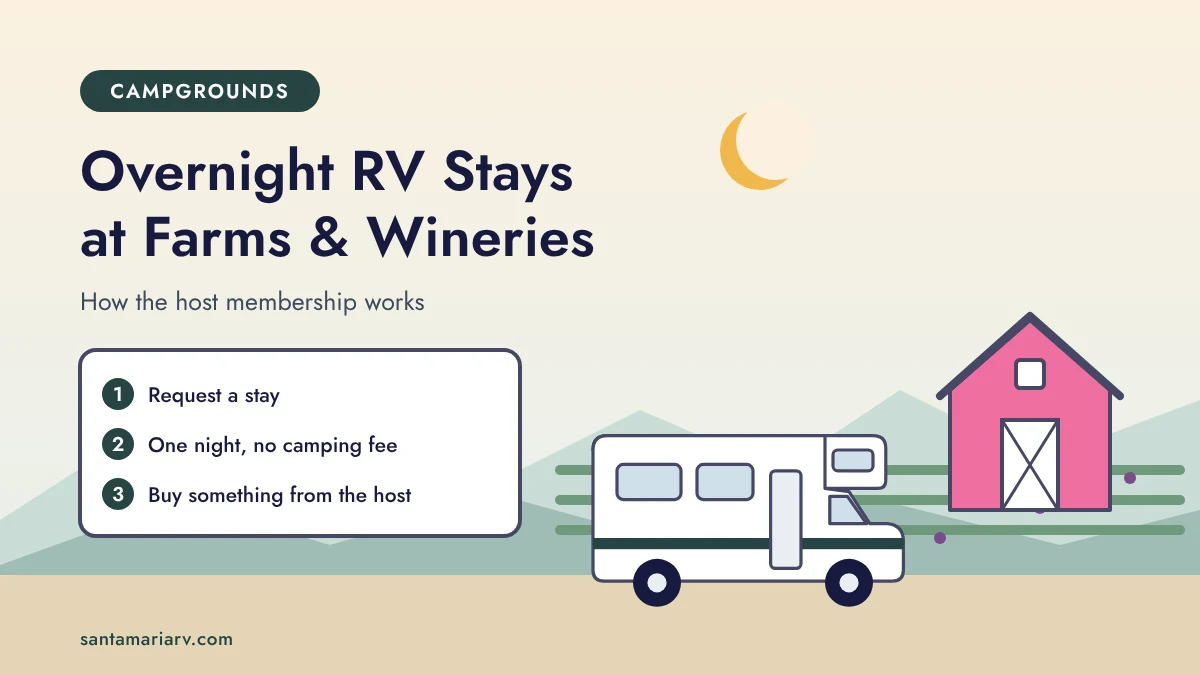
Harvest Hosts is a paid membership that lets self-contained RVs park overnight at farms, wineries, breweries, museums and other small businesses without a camping fee. In this Harvest Hosts review we cover how it works, what it costs as of November 2026 and who gets the most from it. The short version: the basic plan is $99 per year, the standard stay is one night, and members are expected to buy something from each host.
Harvest Hosts Plans and Prices at a Glance
Harvest Hosts sells several plans. The table uses the regular annual prices from the company’s membership comparison in its help center (dated February 2026) and its plans page (checked November 2026).
| Plan | Regular price per year | What you get | Typical stay |
|---|---|---|---|
| Harvest Hosts Classic | $99 | Over 5,700 business hosts (farms, wineries, breweries, attractions) | One night, no nightly fee |
| Boondockers Welcome (sold separately) | $79 | Over 3,400 hosts, mostly private property | 1 to 5 nights, set by the host |
| Harvest Hosts + Boondockers Welcome | $169 | Both networks | Depends on the host |
| All Access | $179 | Classic, Boondockers Welcome, Golf Hosts and an Escapees RV Club membership; over 9,300 hosts | Depends on the host |
When we checked the plans page in November 2026, it showed lower figures next to each regular price: $69.30 for Classic, $118.30 for Harvest Hosts + Boondockers Welcome and $125.30 for All Access. The company’s How It Works page calls $69.30 a first-year price. According to the help center article on costs and renewals, promotional pricing applies only to new members, coupons do not stack with renewal rates, and taxes depend on where you live (its example is $1.76 in tax on a $99 renewal).
Prices as of November 2026. Check current rates on the Harvest Hosts plans page before you join; sale prices change often.
How Does Harvest Hosts Work?
The idea is simple. Instead of paying a camping fee for the first night, you support the host’s business. The company’s guide to how it works says: “Instead of paying camping fees your first night, you support your Host by buying something during your visit.”
A typical stay goes like this:
- Find a host on the website or app map. Host profiles list preferred arrival hours, the size limits they accept and the RV parking area, according to the company’s etiquette guide.
- Send a stay request for a specific date. The help center says hosts open their calendars 60 to 180 days ahead, most use the default of 90 days, and some allow same-day requests.
- Wait for approval. Harvest Hosts recommends waiting 24 to 48 hours for a reply. Some hosts answer quickly, while others review requests once a week. The etiquette guide is clear: wait for the confirmation email before you show up.
- Arrive, check in and shop. Buy wine, produce, a meal, a tour ticket or whatever the host sells.
- Leave the next day. The standard stay is one night.
The How It Works page says about 40% of hosts are within 5 miles of an interstate and over 50% allow same-day requests. That makes the network handy as a stopover on a long drive.
Harvest Hosts Rules You Should Know
Your RV must be fully self-contained
The vehicle rules (updated January 2026) say all camping vehicles must be fully self-contained. The company’s guide defines that as “a built-in interior toilet and an interior cooking setup.” Accepted vehicles include Class A, B and C motorhomes, travel trailers, fifth wheels, toy haulers, truck campers and camper vans. Tents, rooftop tents and sleeping in a car or truck are not allowed.
Outdoor cooking is not allowed at host locations. The vehicle rules say you may use only your RV’s indoor cooking facilities; that includes the outdoor galleys on teardrop and clamshell trailers.
Stays are short
The help center describes Harvest Hosts as “an overnight program with stays of a maximum of 24 hours.” Some hosts now offer extra nights. The Extra Nights page says you can request up to 4 extra nights, the host sets any fee and keeps all of it, and the first night is still free with the recommended purchase. Boondockers Welcome works differently: those hosts allow up to five nights, depending on their preferences.
Hookups, generators and pets
- Hookups: the How It Works page says you can filter for hosts that offer electric or water hookups “for a small fee.” Unless a host’s profile lists hookups, plan to rely on your own tanks and power (dry camping, with no water, sewer or electric connections).
- Generators: the company’s guide says many hosts allow brief generator use during the day and that overnight quiet hours are the norm. Ask your host first.
- Pets: the company’s pages say most hosts are pet-friendly, though they give different shares: the How It Works page says 75% in one place and 95% in another, and the guide says “over 90%”. Farms may have working animals or livestock, so check each host’s profile.
No-shows have consequences
Under the no-show and cancellation policy (updated June 2026), you should cancel before the 24-hour window. A first no-show brings an automatic 1-star member rating, a second brings a follow-up from the member team, and a third can lead to a suspension of up to one year without a refund. If plans change on the day, message the host with a reason: the policy says you then will not be marked a no-show. A few hosts with many no-shows may hold a credit card to guarantee the space.
Do You Have to Buy Something?
Yes, in practice. The company’s article on purchases during a stay (April 2026) says members are “strongly encouraged” to buy something and that “a general guideline is to spend about $30 per night’s stay.” It also warns that a member who does not support the host may get a poor review from that host. If a host charges for extra nights, the same article says the first night’s purchase plus the extra-night fees should be enough.
Keep this in your budget. A year of Classic plus ten one-night stays at the suggested $30 each comes to $99 + $300 = $399, although the $300 buys you goods you chose, such as a bottle of wine, a farm box or a meal.
What Changed in 2024–2026
The company behind the membership has grown and changed owners, which is worth knowing before you pay for a year:
- Escapees: in July 2024 Harvest Hosts acquired the membership and events portion of Escapees RV Club; Escapees mail forwarding and RV parks stayed separate, overseen by Travis and Melanie Carr.
- All Access price: since March 2025, the All Access plan includes Escapees RV Club. The help center notes that legacy All Access rates of $129 rose to $179 to cover Escapees and new features.
- Choice Hotels: Choice Hotels announced in September 2026 that it would buy Harvest Hosts at an enterprise value of about $130 million and that Harvest Hosts would keep operating as a standalone business under its own brand. The hotel company’s third-quarter 2026 results say it acquired Harvest Hosts on October 1, 2026. The September announcement put the network at more than 11,200 host locations.
Host counts differ between the company’s own pages because each plan includes different networks. Compare plans by the number the help center lists for the plan you are buying.
Boondockers Welcome vs Harvest Hosts
Both are now run by the same company, but they suit different trips:
| Harvest Hosts Classic | Boondockers Welcome | |
|---|---|---|
| Hosts | Small businesses | Mostly private property |
| Price (regular) | $99 per year | $79 per year |
| Length of stay | One night, plus up to 4 extra nights where offered | 1 to 5 nights, set by the host |
| Hookups | Some hosts, for a small fee | Many hosts offer them |
Sources: Harvest Hosts help center, stay length article, Extra Nights page, How It Works page, as of November 2026.
If you want an interesting overnight stop with a meal or a tasting, Harvest Hosts fits. If you want to stay a few nights on a private host’s property, Boondockers Welcome is closer to classic boondocking. Our guide to RV boondocking explains how to manage water, power and waste without hookups.
Is Harvest Hosts Worth It? Our Review Verdict
The bottom line of this Harvest Hosts review: the membership is worth it if you will use it several times a year and enjoy the stops themselves. It is a poor fit if you need hookups every night or want to stay put for a week.
It tends to work well for:
- Couples on long drives who want a pleasant overnight stop instead of a rest area or a store lot. For the free alternative and its limits, see our guide to Walmart overnight parking.
- Snowbirds heading south who drive for several days and stop once a night.
- Travelers who enjoy local food and wine and would spend money at a winery or farm stand anyway.
Think twice if you:
- Rely on electric power at night, for example to run the air conditioner in summer heat or to power medical equipment such as a CPAP. Only some hosts offer hookups, for a small fee, so plan your battery and generator capacity, or filter for hosts that offer electric.
- Drive a long motorhome or tow a car. Host profiles list the size limits they accept; check the parking area before you request. Our guide to RV classes lists typical lengths by type.
- Live on the road full time and want longer stays. Boondockers Welcome or campgrounds usually fit better; see our guide to full-time RV living.
The risk of trying it is limited. The refund policy says new Harvest Hosts and Boondockers Welcome memberships can be refunded within 90 days if the account has two or fewer completed stays, with one refund per account. Renewals can be refunded within 30 days if no stays were completed since renewal.
Before you join, open the map and look at hosts along a route you actually plan to drive this year. Count how many nights you would realistically use a host, then compare that with the plan price and the suggested $30 purchase per stay.
Frequently Asked Questions
How much does a Harvest Hosts membership cost?
The Classic plan costs $99 per year at the regular price, Boondockers Welcome $79, the combined plan $169 and All Access $179, according to the Harvest Hosts help center and plans page (as of November 2026). New members often see a first-year discount; for example, Classic was listed at $69.30. Taxes depend on your location.
Do you have to buy something at Harvest Hosts?
Harvest Hosts strongly encourages it. The company suggests spending about $30 per night at the host’s business, for example on wine, produce, a meal or admission. The purchase replaces a camping fee for the first night. Members who skip it may receive a poor review from the host.
How long can you stay at a Harvest Hosts location?
The standard stay is one night, with a maximum of 24 hours. Some hosts offer up to 4 extra nights, sometimes for a fee that the host sets. Boondockers Welcome hosts, a separate network from the same company, allow 1 to 5 nights depending on the host’s preferences.
Can you stay at Harvest Hosts without a bathroom in your RV?
No. Harvest Hosts requires every camping vehicle to be fully self-contained, which the company defines as a built-in interior toilet and an interior cooking setup. Tents, rooftop tents and sleeping in a car or truck are not allowed, and outdoor cooking is prohibited at host locations.
Who owns Harvest Hosts now?
Choice Hotels International acquired Harvest Hosts on October 1, 2026, in a transaction of about $130 million, according to Choice Hotels’ third-quarter 2026 results. Choice said Harvest Hosts would continue to operate as a standalone business under its existing brand. Harvest Hosts itself has owned the Escapees RV Club membership business since 2024.