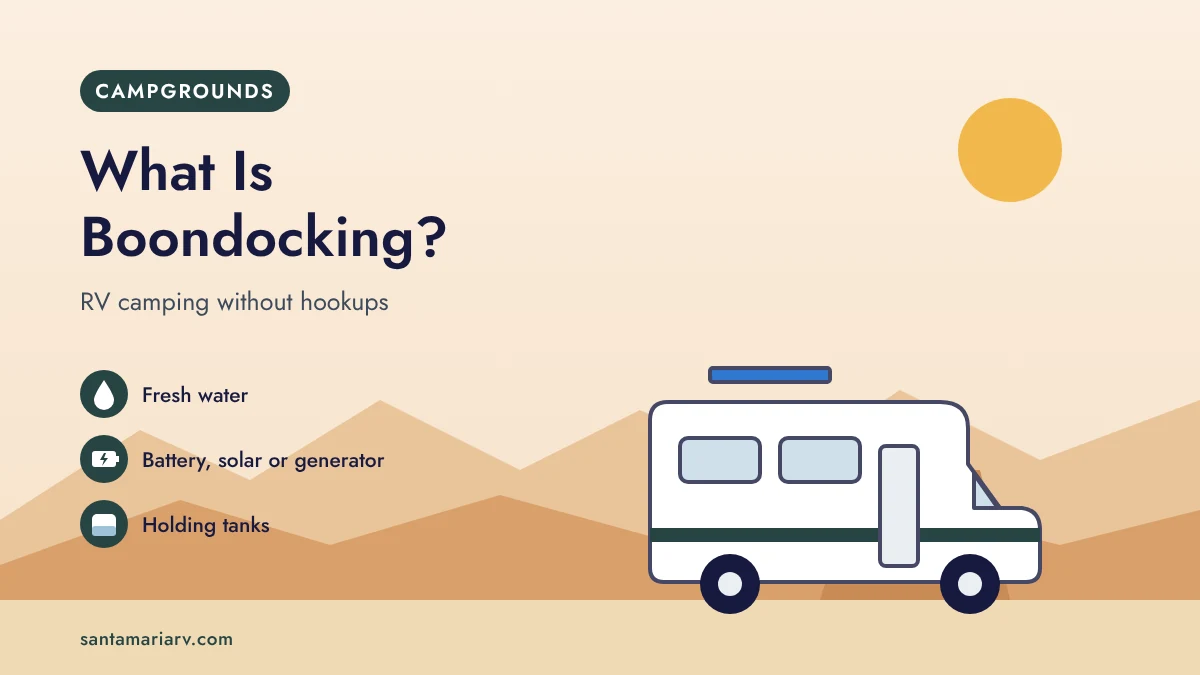
What is boondocking? It is camping in your RV outside an established campground, with no water, sewer or electric hookups — and usually for free. Boondockers Welcome defines it as “camping, in an RV, for free, outside of an established campground, without hookups or access to other amenities.” You rely on what your RV carries: the fresh water tank, the holding tanks, the batteries and any solar or generator power.
For retirees who travel for months at a time — see our guide to full-time RV living — boondocking offers quiet sites, wide views and stays that cost nothing. It does take planning. This guide covers the kinds of boondocking, the rules on public land, and how to get your RV ready.
In this guide:
- Boondocking vs dry camping vs dispersed camping
- Where you can boondock
- Rules on BLM and national forest land
- Getting your RV ready: water, power and waste
- Safety and comfort tips
- Etiquette and leaving no trace
Boondocking vs Dry Camping vs Dispersed Camping
The terms overlap, and people use them loosely, so the answer to “what is boondocking” can shift depending on who you ask. Boondockers Welcome’s glossary draws these lines:
| Term | What it means |
|---|---|
| Boondocking | Free RV camping outside an established campground, with no hookups or amenities |
| Dry camping | Camping in an RV without hookups — this can be inside a campground that has no hookups at that site |
| Dispersed camping | Free camping outside an established campground on public land, in an RV, a tent or with no shelter |
| Moochdocking | Boondocking on a friend’s or relative’s property |
In practice, “boondocking” usually means dispersed camping on public land, but RVers also use it for overnight stays at host locations and parking lots.
Where Can You Boondock?
Public land: BLM and national forests
Most RV boondocking on public land happens on land managed by the Bureau of Land Management (BLM) and the U.S. Forest Service. The BLM says it manages about 245 million acres of public land, located primarily in 12 western states, including Alaska. Both agencies allow dispersed camping in many places, with stay limits and rules covered in the next section.
Host networks
Membership programs connect RVers with private hosts. Harvest Hosts says it offers “9,700+ farms, wineries, breweries, distilleries, museums” across North America (as of May 2026). The standard stay is one night, and every member “needs a fully self-contained rig, meaning a built-in interior toilet and an interior cooking setup.” The company suggests members spend $30 at the host’s business per one-night stay.
Overnight parking
Some businesses allow RVs to park overnight in their lots; Boondockers Welcome calls this “blacktop boondocking.” Policies can differ from one location to the next and local rules may limit it, so ask the manager and look for posted signs. As a courtesy, treat a parking-lot overnight as a rest stop rather than a campsite: keep chairs, awnings and slide-outs in unless you’re told it’s fine.
Rules for Boondocking on Public Land
BLM land
According to the BLM’s camping guidelines, “you may usually camp in an area for up to 14 days before having to move at least 25 miles from your original spot,” and you “may not return to that area for 28 consecutive days.” RVers call this the 14-day rule. The BLM’s camping page adds that “specific stay limits vary by state and field office,” so check posted signs and the field office page for the area you plan to visit (rules as of November 2026).
The same BLM guidance asks campers to:
- camp at least 200 feet from water sources;
- choose sites that are already established;
- use existing fire rings or camp stoves, and check current fire conditions;
- dispose of human waste away from water in a hole at least 6 inches deep.
National forests
The U.S. Forest Service says you may camp in a dispersed area “for a limited number of days set by the forest” — each national forest sets its own stay limit, so check before you go. Key rules from the same page:
- Dispersed camping is typically not allowed near developed recreation areas such as campgrounds, picnic areas and trailheads.
- Where you can drive and park to camp is shown on each forest’s Motor Vehicle Use Map (MVUM). The Forest Service describes MVUMs as free maps that each forest posts online; they may also be found at visitor centers.
- Camp at least 200 feet from any stream or other water source.
- No amenities are provided, such as water, restrooms or trash cans. Pack out all trash, leftover food and litter.
- Campfires are permitted unless a restriction has been issued; restrictions are common in hot, dry periods.
Fire restrictions change quickly in summer and fall. Check the BLM field office or national forest page — or call the ranger station — on the day you arrive, not a week earlier.
Getting Your RV Ready for Boondocking
Boondocking comes down to three questions: how long your water lasts, how long your power lasts, and how long your holding tanks last. Whichever runs out first sets the length of your stay.
Water
- Arrive with a full fresh water tank. Your owner’s manual lists its capacity.
- Carry extra drinking water in jugs.
- Save water with short showers, a low-flow shower head, and dishes washed in a basin.
Power
- Batteries: on most RVs, the 12-volt house batteries (the ones that power the living area, not the engine) run lights, the water pump, the furnace fan and the refrigerator controls. Know their usable capacity and how to read your battery monitor.
- Solar: roof or portable panels recharge batteries during the day without noise.
- Generator: can run the air conditioner and microwave, if it is sized for them, and recharges batteries faster than solar. Follow posted quiet hours; Harvest Hosts notes that many hosts allow brief generator use during the day, with quiet hours overnight the norm.
- Keep propane tanks full: in many RVs propane runs the furnace, stove, water heater and, often, the refrigerator. Your owner’s manual shows which appliances use it in your rig.
Waste
- Start with empty black and gray tanks.
- Know where the nearest dump station is before you go.
- Never dump gray or black water on the ground. The Forest Service asks campers with trailers to dispose of waste and gray water at dump stations, which are located at many Forest Service campgrounds.
Do a “test boondock” in a campground before you go remote: turn off the hookups for a weekend and see which runs out first — water, power or tank space. You’ll learn your real limits with help nearby.
Safety and Comfort Tips for Boondocking
- Scout the road and the site. Many dispersed sites are reached on gravel or dirt roads. Check road conditions with the ranger station, and if you have a big rig, look at the site on foot or in your tow car before driving in.
- Arrive in daylight. It is much easier to judge the ground, the slope and the turnaround space.
- Check cell coverage and tell someone where you are. Leave your location and return date with family or friends, especially in remote areas.
- Bring your medications and a first-aid kit, plus extra days’ supply in case weather keeps you in place.
- Watch the weather. Wind, heat and flash floods matter more when you are far from services.
- Level the RV so the refrigerator, doors and slides work properly.
Boondocking Etiquette and Leave No Trace
- Use existing campsites and fire rings instead of making new ones (BLM).
- Keep your distance from other campers — the quiet is the point.
- Pack out everything you bring, including trash and leftover food (Forest Service).
- Keep generator time short and never run it during quiet hours.
- On private host sites, follow the host’s rules about pets, arrival times and generators, and support the business if it is a farm or winery.
Getting Started: A Simple Checklist
- Practice one weekend without hookups.
- Learn your fresh, gray and black tank capacities and your battery capacity.
- Pick a first site close to town, with cell coverage and an easy road.
- Check the stay limit, fire restrictions and MVUM for that area.
- Fill water and propane, empty tanks, charge batteries.
- Tell someone where you’ll be.
Frequently Asked Questions
Is boondocking legal?
Yes, where it is allowed. Dispersed camping is permitted on much BLM and national forest land, with stay limits and rules set by each office or forest. On private property — including store parking lots — you need the owner’s permission, and local rules may prohibit overnight parking.
How long can you boondock on BLM land?
The BLM’s general guidance is up to 14 days in one area, after which you move at least 25 miles and do not return to that area for 28 consecutive days. Local field offices can set different limits, so check the page for the area you’re visiting.
What is the difference between boondocking and dry camping?
Boondocking is free camping outside an established campground without hookups. Dry camping simply means camping in an RV without hookups, which can also happen inside a campground at a site with no water, sewer or power.
Do you need a generator to boondock?
Not necessarily. Batteries and solar panels can cover lights, the water pump, the furnace fan and small electronics. A generator helps if you need air conditioning or a microwave, or have little sun. Follow quiet hours if you use one.
Can any RV go boondocking?
Most self-contained RVs can — those with a toilet, holding tanks, fresh water and batteries. Large rigs need roads and sites that fit their length and clearance, so scout ahead; our guide to RV classes lists typical lengths. Membership networks such as Harvest Hosts require a fully self-contained RV.